After 7 Hiring Failures, Here’s How I Spot Top Sales Talent
PhD in Failures, Volume 23

After winning your “patent lawsuit” moment (see PhD in Failure, Volume 21), it’s time to build your organization. You’ve started blazing past $1M in sales — congratulations (See PhD in failure Volume 9 and Voliume16) ! — and now comes the real challenge: hiring your sales team.
I’ve made every mistake possible while building enterprise sales teams. Over the next few posts, I’ll share these lessons so you don’t have to relearn them the hard way.
Today, we focus on hiring, because 95% of salespeople are, frankly, BS artists and lazy.
Finding the right ones is like finding a needle in a haystack — but you, founder, can do it if you know what to look for.
Step 1: Know Your Resources
If you have VC funding: Hire a dynamic sales leader first. With their help, you can build a team under them and ensure your hiring process incorporates the best practices below. They’ll focus on spending money efficiently to quickly build a sales machine — hiring SDRs and scaling the team. A tip: Make sure they can show examples of compressing the sales cycle in past engagements. Your VC network is often the best place to find these candidates.
If you’re bootstrapped: You’ll likely hire via LinkedIn or recruiters or meetups. Here’s how you can weed out the 95% of salespeople who aren’t fit — especially when hiring your first one or two sales hires.
Step 2: Understand the Sales Talent Landscape
Salespeople generally fall into three categories:
70% feature-driven: Talk about product features but don’t sell real value.
15% value-driven: Ask about customer pain points and sell meaningful solutions.
5% elite performers: Create a need the customer didn’t even know existed.
Your mission: identify the top 20% and avoid the 70%.
Finding someone in the 5% is rare — divine luck. The next best are in the 15%, and you can identify them with a simple test:
“Sell me a pen” (or anything else).
Jump straight into features → stop immediately.
Ask about your pain points first → 15% candidate.
Create a need you didn’t know you had → elite 5% candidate.
This simple test helps you weed out the 70% who won’t drive real results.
Step 3: Ask How They Qualify Prospects
Many founders — and even seasoned salespeople — fail here. The key is strategic filtering. Think of any industry as a pyramid:
Top: Big players
Middle: Mid-sized companies
Bottom: Small enterprises
You can’t sell to everyone day 1. Strategic filtering lets you focus and close deals faster.
One effective method: classify prospects as Hot, Warm, or Cold leads:
Hot: Prospects who already know you (not the ones you know). Close in <90 days as they trust you , believe in you and will give you an opportunity to prove yourself.
Warm: Second-degree connections (your network knows them). Close in <180 days
Cold: Unknown prospects. Mass outreach required; ~1% conversion is realistic.
Founder’s goal: Ask your candidates how they would qualify prospects using a framework like this.
Red flag: If they can’t explain a structured approach, they’re likely the wrong hire.
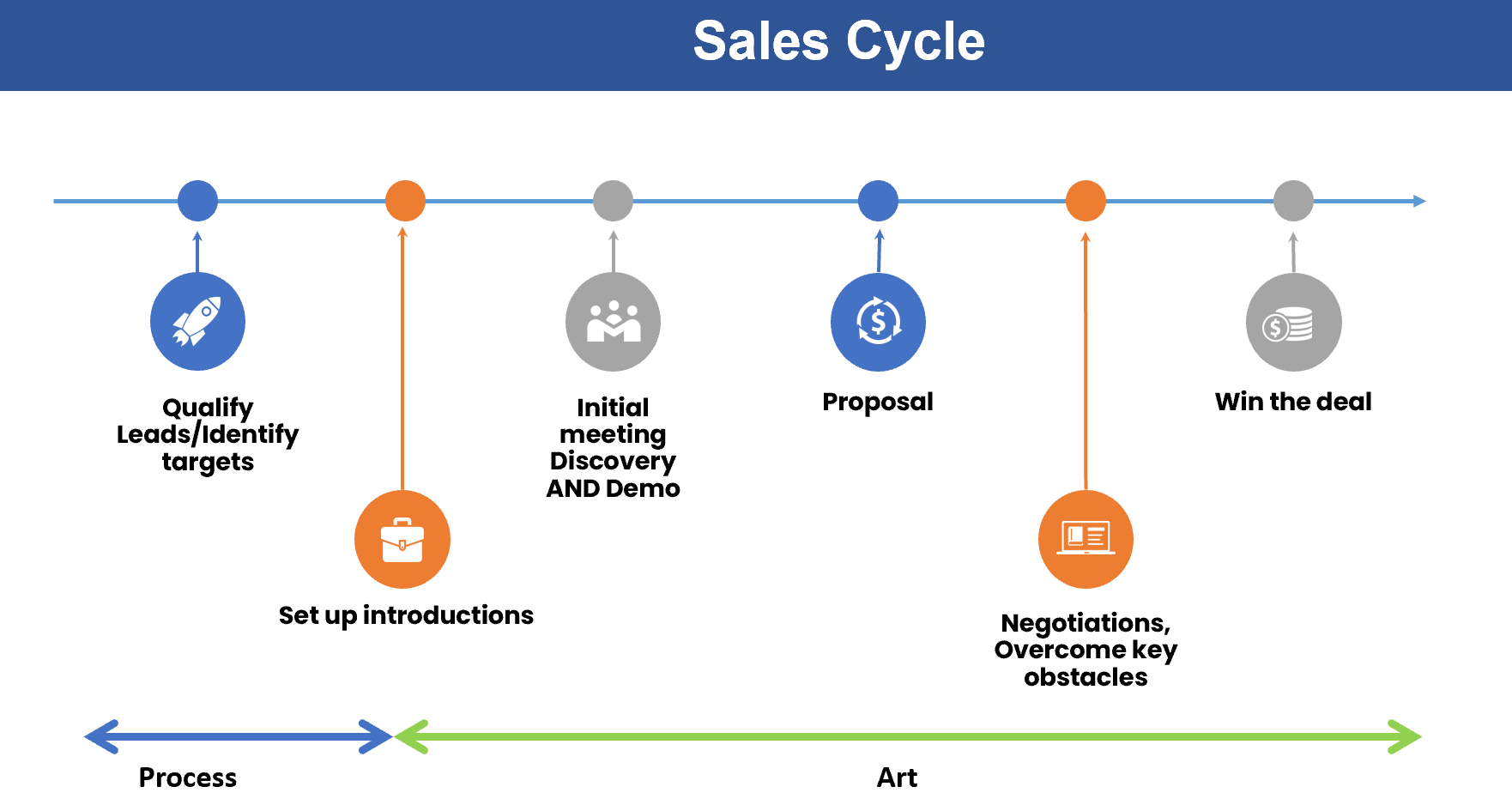
Step 4:Ask them to Walk you Through the Sales Cycle
Ask candidates to walk you through their sales cycle and what they’ve done to compress it in past engagements.
A typical enterprise sales cycle has clear phases (see figure below). If a candidate can’t explain them clearly, they’re likely not the right hire.
Step 5: Are They an Opener or a Closer?
Many salespeople will answer a fair split 50/50 between opening and closing. You want your candidate to identify their strength — opener or closer — and dig deeper, so ask them to put higher weightage on one of the two.
If they say closer is higher weightage, ask:
Give examples of good vs. bad negotiation questions you would ask a client after a demo or during a proposal?
Good negotiation questions are CLOSE ENDED questions (move deals forward):
“What is the decision criterion at your organization?”
“Can we start a trial?”
Bad negotiation questions, OPEN ENDED (vague, stalling):
“What do you think of our solution?”
This reveals whether they are dealmakers or talkers.
If they say opener is higher weightage, ask:
Give me examples of good open-ended relevant questions you would ask to uncover client pains/needs:
Good Openers, ask great OPEN ENDED questions
· What are your few most cumbersome workflows daily?
· What will help you double your sales?
Bad Open-Ended questions
· Can you tell me about your company?
Note: These questions are just example, unfortunately every prospect is different to an extent so evaluate if sales candidate have smarts to ask questions which make sense
Step 6: What Makes a Good Demo Agenda?
Ask: “What does a strong demo agenda look like?” A good candidate understands how to structure a demo to engage and persuade decision-makers.
Typical effective agenda:
10 min – Discovery: Understand prospect pain points and goals
40 min – Value Presentation: Show how current users achieve results
5 min – Q&A: Handle objections and questions
Red flag: Candidates who can’t outline a structured agenda likely lack experience in selling value.
Step 7: Who Do You Need to Convince to Close an Enterprise Sale?
Ask: “Who are the key people to convince?”
Enterprises usually have three stakeholder types:
Users – People using the product day-to-day
Influencers – Guide or influence decisions
Decision Makers – Approvers of the purchase
Smaller companies may combine roles; larger ones likely separate all three.
A tip: If candidate starts with users or influencers for initial meetings, then work toward decision-makers is a good sign. In general, how your sales candidate navigates this reveals their strategic thinking.
Step 8: Incentives Matter
Once your candidate passes all prior checks, design a competitive Sales Incentive Plan (SIP):
50% Base / 50% On-Target Earnings (OTE)
OTE tied to quarterly goals: 80% goal met = $X incentive, 100% goal met = $Y incentive, 110%+ = accelerators
Legal clarity: In software sales, OTE typically applies to first-year sales only
A tip: Use AI tools today to design SIP and OTE to avoid costly mistakes.
In the next post, I’ll show you how to make your salespeople effective from Day 7, not Day 90, based on the mistakes I made the hard way. Stay tuned.
About the Author
I’m Doctor Fail — a founder who turned failure into a multi-million dollar lesson. I share the raw stories no one talks about so you can skip the pain and grow faster. Today, I mentor startups and write PhD in Failure to help you navigate the grind from 0 to 1.
Dr. Fail
Still learning. Still falling forward.