Building the Customer Success Engine — Part 1: Hiring
PhD in Failure — Volume 26

In Volume 25, we answered a foundational question:
When should Sales and Customer Success split—and how?
But that was just the surface.
Because once you decide to introduce Customer Success, a much harder problem begins:
Who do you actually hire—and why do most CSM hires fail?
This is where things get real.
Not org charts.
Not theory.
Execution.
And if you get this wrong, everything from Volume 25 breaks:
handoffs fail
customers lose trust
adoption drops
expansion slows
I learned this the hard way.
After building a CSM function across 70+ enterprise clients (each with market cap of 200M+) in less than two years and hiring/firing double-digit CSMs, here’s the uncomfortable truth:
Most founders don’t fail at Customer Success strategy.
They fail at Customer Success hiring.
Let’s answer the real questions.
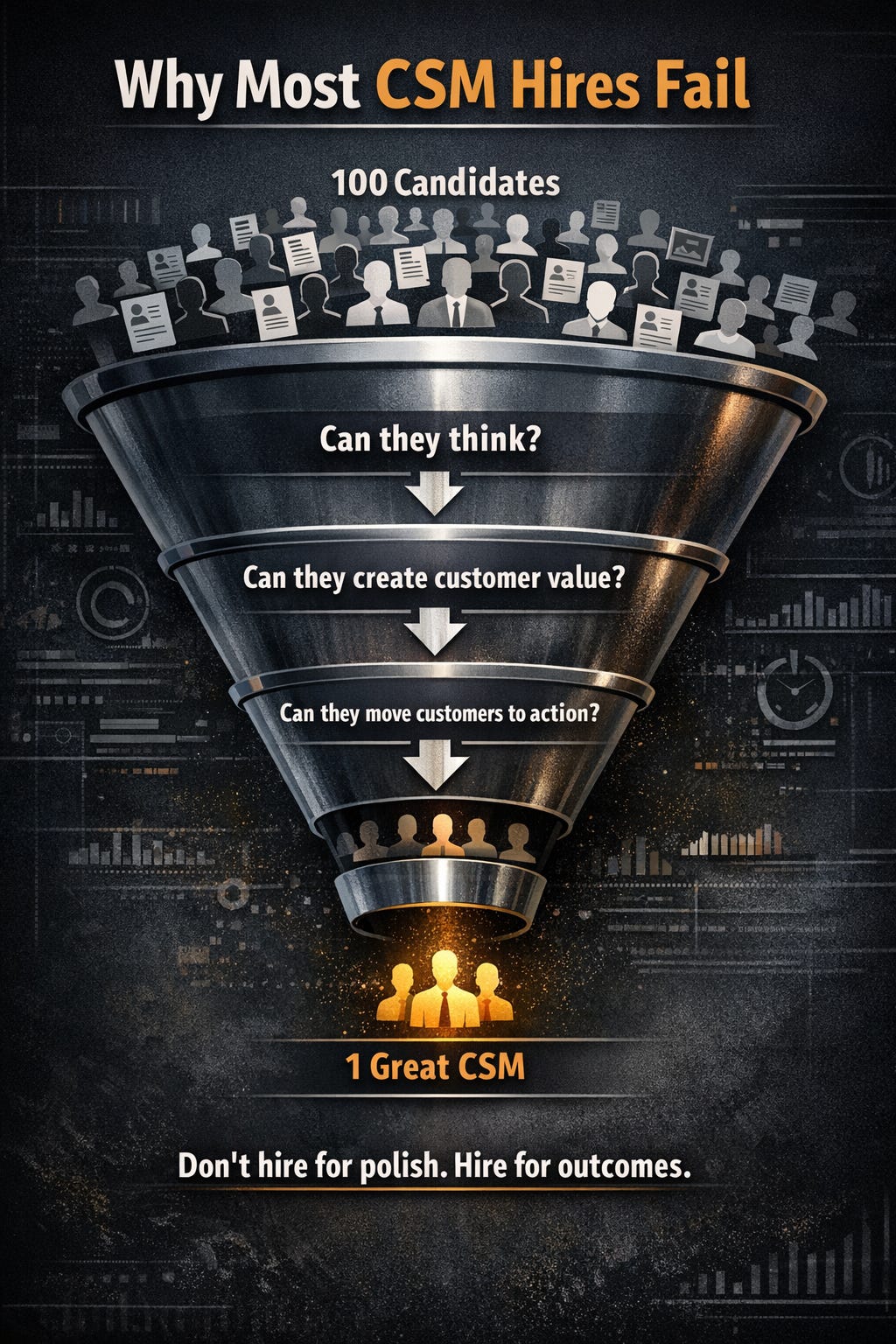
1) “Can I just hire a great CSM and solve this?”
Short answer: No.
Long answer:
You’re not hiring a role.
You’re designing a system.
And most founders skip that step.
They assume:
“If I find the right person, things will work.”
That’s backwards.
If the role is unclear, even great people fail.
And in early-stage companies, the role is always unclear.
Because you’re still figuring out:
what “good adoption” looks like
how much hand-holding customers need
where value actually comes from
how often customers should engage
So your first CSM hire isn’t just executing.
They’re helping you discover the playbook.
2) “What type of CSM should I hire?”
This is where most founders lose time and money.
The default instinct is usually one of these:
“Let’s hire someone strong with customers.”
Or:
“Let’s hire someone who understands the domain.”
Both sound reasonable.
Both fail—when taken alone.
Mistake #1 — Hiring the “relationship-first” CSM
They:
communicate well
build rapport quickly
keep customers happy
But then something subtle happens.
Customers like them…
…but don’t change behavior.
Adoption doesn’t improve.
Usage doesn’t deepen.
Value doesn’t expand.
Because the CSM cannot push thinking forward.
Being liked is not the same as creating customer outcomes.
Mistake #2 — Hiring the “domain expert” CSM
They:
understand the product deeply
speak the customer’s language
know the industry
But then another problem shows up.
They struggle to:
drive urgency
structure conversations
influence decisions
create momentum
They understand the problem.
But they don’t move the customer.
Knowledge without momentum is not Customer Success.
The reality
A strong CSM needs both:
credibility (domain / product understanding)
influence (customer + business instinct)
And that combination is rare.
Unicorns exist—but they are not a hiring strategy.
3) “So what actually works?”
After multiple failed models, here’s the most practical answer:
Stop chasing perfect individuals. Start designing complementary roles.
Instead of forcing one person to do everything, think in combinations:
someone who understands customers and business
someone who understands product and domain
This could look like:
AE + CSM
CSM + technical specialist
or hybrid roles evolving over time
But one thing must be crystal clear:
Ownership
If you don’t define:
who owns adoption
who owns follow-ups
who owns executive trust
who owns expansion signals
You will recreate the exact friction from Volume 25.
And customers will feel it before your team does.
Ambiguity inside your team becomes inconsistency for your customer.
4) “Should I hire a Customer Success leader first?”
A lot of founders think this is the shortcut and after we kept failing few times, we fell prey to the same.
“Let me hire a strong Head of Customer Success and let them build the whole thing.” This might work in Silicon Valley but if you are outside they valley not easy
We did it twice and it failed. Why?
Because most founders hire the leader before they have enough clarity for the leader to lead and frankly speaking its rare to find leaders with proven track record outside the Silicon Valley.
At that stage, you may still not know:
what “good adoption” looks like
what healthy customer behavior looks like
what should be standardized
what should still stay founder-led
So what happens?
The leader starts doing what most smart leaders do:
creating process
introducing structure
building playbooks
trying to professionalize the function
And none of that is wrong.
But here’s the problem:
Process helps good systems scale.
It does not fix a system that hasn’t been discovered yet.
We tried versions of this too:
onboarding plans
scripted questions
customer success workflows, training guides
structured account reviews
Some of it helped.
But none of it solved the deeper issue:
What works at 6 customers often breaks at 10.
What works at 10 breaks at 20.
What works at 20 breaks at 70.
That’s startup life.
My view
A Customer Success leader can be a great hire once your patterns are real enough to scale. If you must hire, hire from Silicon Valley who have proven track records only not from big 4 consulting firms who have stellar consoling backgrounds as but never lead a CSM team before.
But if you hire them too early (in the valley or outside valley), you may simply be paying someone senior to organize confusion.
A strong CS leader should scale your system—not invent your first one for you.
5) “Why do CSM hires fail even when interviews go well?”
Because founders interview for the wrong thing.
Most interviews test:
communication
past experience
generic frameworks
Very few test:
Can this person create value in my business?
So you end up hiring people who:
sound sharp
say the right things
know the terminology
…but struggle in real accounts.
What changed for us
We stopped doing what most founders do.
We stopped Googling:
“Top 10 CSM interview questions”
And we stopped relying on generic AI-generated questions.
Because those questions test one thing:
How well someone interviews—not how well they create value.
Instead, we flipped the approach.
We built questions based on how our product actually creates value for customers.
You should do the same in your market.
Our context
Our product was data-driven intelligence.
The real value came from:
correlating data across multiple systems
extracting insights that were not obvious
helping customers make better decisions from that data
So we asked ourselves:
“What kind of thinking actually creates value here?”
Then we built interview questions around that.
And very quickly:
We weeded out ~95% of candidates.
Not because they were bad people.
But because they could not think in the way our customers needed.
The real lesson
Don’t copy interview questions. Design them.
Because your job is not to find someone who understands Customer Success in theory.
Your job is to find someone who can:
create value in your specific business, for your specific customers.
And generic questions will never test that.
Examples of the questions we asked
If you had to correlate Application X and Application Y, what useful outcome would you create that isn’t obvious at first glance?
(No right or wrong answer — this tests how they think.)If you had a drone flying over operations giving you real-time data, what decisions or value would you create for the user?
(Tests ability to translate data into action.)How do you measure whether Customer Success is actually working—not just activity, but real impact?
(Separates operators from thinkers.)If a user stops responding to calls and emails, what would you do to get their attention without becoming noise?
(Tests creativity and customer instinct.)
If your interview questions don’t reflect how your product creates value, you are hiring blind.
6) “How do I know if I made the right hire?”
Simple:
Ignore the first 2–3 weeks. Watch the first 90 days.
That’s where reality shows up.
A strong CSM will start to:
ask better questions over time
understand customer patterns
identify gaps you didn’t see
create structure where there was none
slowly build trust without forcing it
A weak CSM will:
stay reactive
rely on you for direction
struggle to drive conversations
keep meetings “pleasant” but not productive
Customer Success is not about activity. It’s about forward movement.
And movement becomes obvious within 90 days.
My Bottom Line (After Too Many Mistakes)
If you’re a bootstrapped founder building your CS function, here’s what I would do again:
Delay hiring until patterns emerge
Design the role before hiring the person
Prioritize thinking ability over résumé
Accept that no single hire will be perfect
Build around complementary strengths
Judge hires based on customer movement, not activity
And the most important shift of all:
You are not hiring someone to manage customers.
You are hiring someone to create outcomes when you are no longer in the room.
That’s the job.
Everything else is noise.
What’s Next
Hiring is just the first layer.
Even great hires fail without structure.
In the next volume, I’ll break down:
How to onboard and train a CSM in the first 90 days
Because that’s where many early Customer Success teams quietly break.
About the Author
I’m Doctor Fail — a founder who turned failure into multi-million-dollar lessons.
I share the raw stories no one talks about, so you can skip the pain and grow faster.
Today, I mentor startups and write PhD in Failure to help founders navigate the grind from 0 to 1.
Dr. Fail
Still learning. Still falling forward.
So beautiful
Makes us all better. Thanks for sharing doc!